

10 Shocking Animals That Change Gender
Discover how these remarkable creatures defy biology’s basic rules and why evolution gave them this extraordinary superpower.
When Biology Gets Seriously Creative
Imagine waking up one day and discovering you’ve transformed into the opposite sex. Your body has restructured itself, your hormones have completely flipped, and you’re now capable of a completely different reproductive role. Sounds like science fiction, right?
For certain animals that change gender, this isn’t fantasy; it’s a survival strategy that’s been perfected over millions of years.
In the intricate tapestry of nature’s design, some species have evolved one of the most fascinating biological abilities imaginable: the power to switch their sex during their lifetime. This phenomenon, scientifically known as sequential hermaphroditism, challenges everything we think we know about the permanence of biological sex.
These transforming animals that change sex remind us that nature operates on principles far more creative and flexible than we might imagine. Just like ants that can lift 50 times their body weight, these sex-changing fish possess abilities that seem impossible, yet they’re happening right now in oceans around the world.
Today, we’re diving deep into the lives of 10 incredible gender-changing fish and other creatures that can literally transform their bodies. From the colorful residents decorating coral reefs to mysterious deep-sea dwellers, prepare to have your understanding of biology completely transformed.
Table of Contents
What Does It Mean to Change Gender?
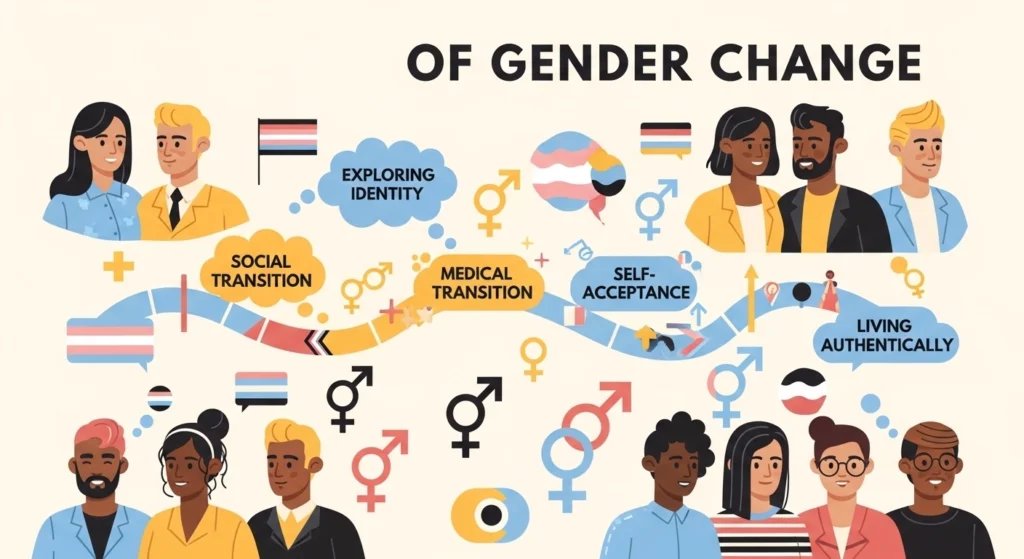
The Science Behind Sex Change in Animals
Before we explore our list of animals that change gender, let’s clarify what we mean by “changing sex.” In biological terms, we’re talking about sequential hermaphroditism when an animal physically transforms from one functional sex to another during its lifetime.
Key Terms to Know:
- Protandry: Starting life as male, then becoming female
- Protogyny: Starting life as female, then becoming male
- Simultaneous Hermaphrodite: Being both sexes at the same time
- Sequential Hermaphrodite: Being one sex, then switching to another
This isn’t about identity or expression, it’s about complete physiological transformation. These hermaphroditic species undergo:
✓ Hormonal restructuring
✓ Physical organ development
✓ Behavioral changes
✓ Complete reproductive capability in their new sex
Why Would Evolution Create This Ability?
The evolutionary advantages of fish sex reversal are profound:
Maximizes Reproductive Success: Being the optimal sex at the optimal size
Adapts to Social Dynamics: Fills critical roles when the breeding hierarchy changes
Increases Genetic Diversity: More flexible mating strategies mean healthier populations
Survival in Isolated Populations: Ensures breeding pairs always exist, even in small groups
Much like poison dart frogs evolved toxic skin as a defense mechanism, gender-changing animals developed this ability to solve specific survival challenges in their environments.
1. Clownfish: The Family That Rewrites Itself
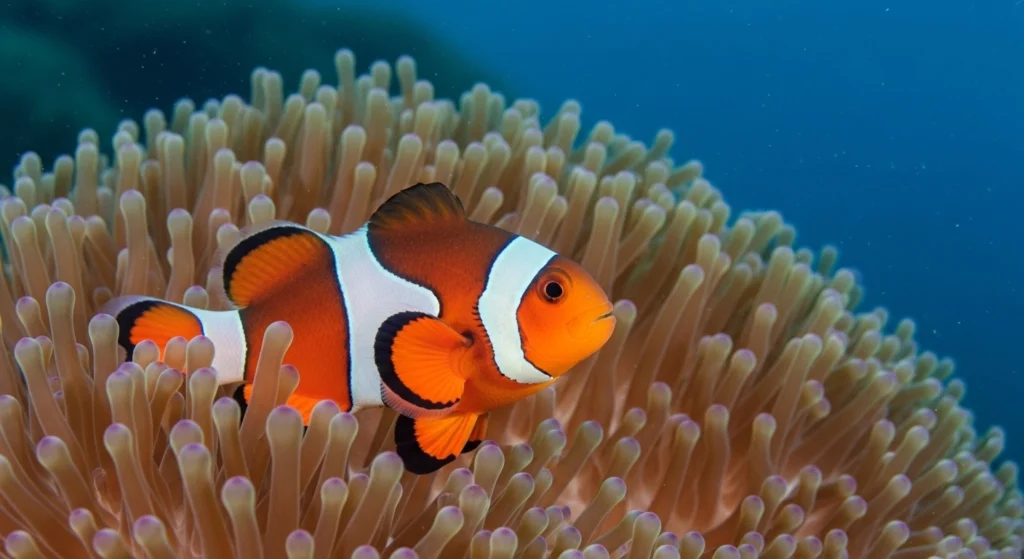
Scientific Name: Amphiprioninae
Type of Change: Protandrous (male to female)
Habitat: Sea anemones in tropical waters
The Real Story Behind Finding Nemo
Remember the beloved Pixar movie “Finding Nemo”? The heartwarming story of a father searching for his son actually glosses over a fascinating biological reality. In the real world, when Nemo’s mother died, his father, Marlin, would have transformed into a female. Then, Nemo himself would have matured into the breeding male of their anemone.
Not exactly the family-friendly version we saw on screen! But this is how animals that change gender actually work in nature.
How Clownfish Transform Their Sex
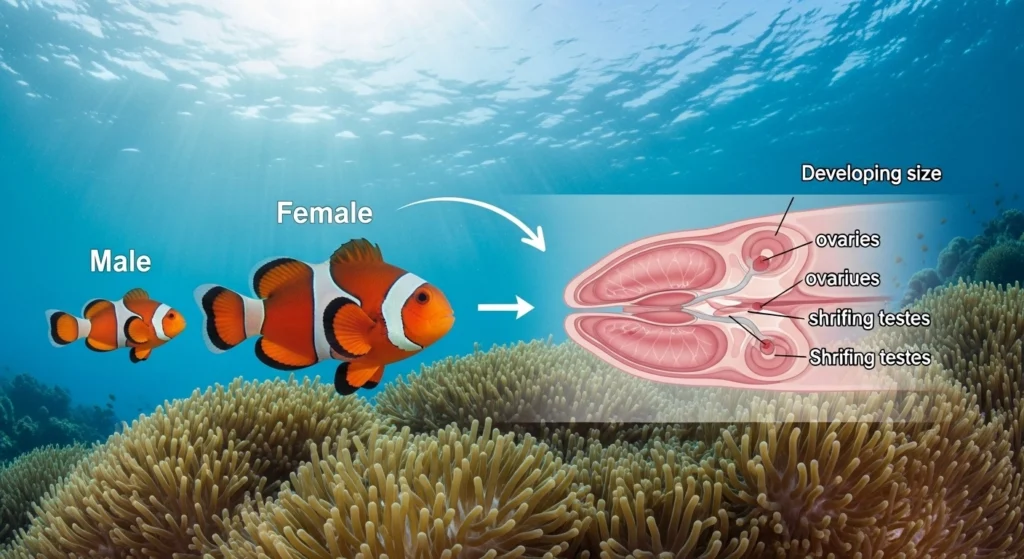
Clownfish societies are strict matriarchies with a clear hierarchy. These sex-changing fish live by simple rules:
The Hierarchy:
- Position 1: Largest fish = Breeding female (most dominant)
- Position 2: Second-largest = Breeding male
- Positions 3+: Non-breeding males (juveniles)
When the female dies or disappears, an extraordinary transformation begins. This is one of nature’s most fascinating examples of fish gender transformation:
- Week 1-2: The dominant male’s behavior becomes more aggressive and territorial
- Week 2-3: Hormonal changes begin, testicular tissue starts degrading
- Week 3-4: Ovarian tissue develops and matures
- Day 26: Transformation complete, fully functional female
The Biological Trigger
What initiates this change in these animals that change sex? Primarily, social dominance and the absence of the female. Clownfish can sense pheromones and social cues that signal when transformation should begin.
Fascinating Detail: Research published in 2018 identified specific genes that are activated during this transformation, providing scientists with unprecedented insights into how sequential hermaphrodites control sex change at the molecular level.
Why This Strategy Works
Living in a sea anemone is like living in a fortified castle space is limited. Having all fish born male and capable of fish sex reversal when needed means:
- No need to search for mates (dangerous in open water)
- The breeding pair is always the largest, most successful fish
- The population can rebuild even from just two individuals
- Energy efficiency: small males require less food than large females
2. The Rainbow Transformer
Scientific Name: Thalassoma bifasciatum
Type of Change: Protogynous (female to male)
Habitat: Caribbean coral reefs
The Two-Phase Life Strategy
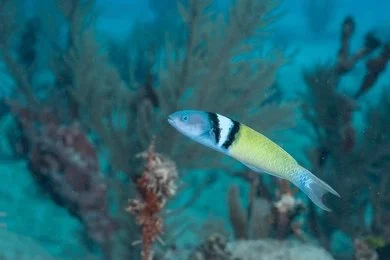
Bluehead wrasse showcase one of nature’s most visually dramatic transformations. These Caribbean sex-changing animals exist in two strikingly different forms:
Initial Phase (IP):
- Smaller body size
- Yellow-brown coloring
- Can be male or female
- Lives in groups
- Less territorial
Terminal Phase (TP):
- Larger body size
- Electric blue head with white band
- Brilliant green body
- Always male
- Highly territorial
- Controls harems of females
The Transformation Timeline
Unlike the weeks-long process in clownfish, bluehead wrasse can transform incredibly quickly, making them some of the fastest gender-changing fish in the ocean:
- Day 1-3: Female begins showing aggressive behavior
- Day 4-7: Color changes begin at the cellular level
- Day 8-10: Blue pigmentation appears on the head
- Day 10-14: Complete terminal-phase male coloration achieved
Scientists can literally watch this marine life gender transformation happen on the reef!
What Triggers the Sex Change?
The primary trigger is the absence of dominant terminal-phase males. When a terminal male dies or is removed from the territory, these animals that change gender spring into action:
- The largest initial-phase females sense the opportunity
- Social competition begins among potential transformers
- The dominant individual begins physiological changes
- Other females suppress their transformation tendencies
Interestingly, some initial-phase males skip the female stage entirely, staying as smaller “sneaker males” who dart in during terminal male spawning to fertilize eggs. Talk about reproductive strategy flexibility!
The Evolutionary Advantage
This system maximizes reproductive output across a fish’s lifespan, a perfect example of why sequential hermaphroditism evolved:
- Early life (small): Being female or sneaker male = produces some offspring
- Later life (large): Being territorial, a terminal male = produces MANY offspring
The bigger you are, the more valuable being male becomes because you can control more breeding opportunities.
3. Kobudai (Asian Sheepshead Wrasse): The Documentary Star
Scientific Name: Semicossyphus reticulatus
Type of Change: Protogynous (female to male)
Habitat: Rocky reefs off Japan and Korea
Yoriko’s Famous Transformation
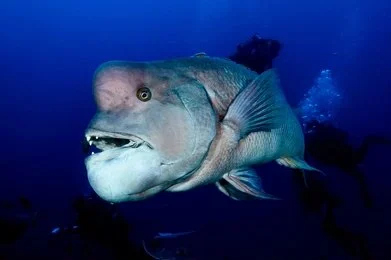
The BBC’s “Blue Planet II” brought this species to global fame by documenting a female named Yoriko transforming into a male over several years. The footage captured one of the slowest, most dramatic fish gender transformations in the animal kingdom.
The Spectacular Physical Changes
The transformation from female to male kobudai is nothing short of astonishing. These sex-changing fish undergo radical body restructuring:
Female Characteristics:
- Reddish-pink body coloration
- Smooth head profile
- Smaller overall size (30-40 cm)
- Subtle features
Male Characteristics:
- Blue-grey body coloration
- Massive forehead protuberance (“melon head”)
- Larger size (60-100 cm)
- Pronounced jaw structure
- Aggressive territorial behavior
The Multi-Year Journey
Unlike rapid transformers, kobudai take their time with protogyny:
- Year 1: Behavioral changes, increased aggression
- Year 2: Gradual color shift from pink to grey
- Year 3: Forehead bump begins developing
- Year 4-5: Full male coloration and structure achieved
Why So Slow?
The extended timeline relates to the dramatic physical restructuring required. That forehead bump isn’t just for show; it’s packed with muscle and connective tissue used in territorial battles with other males. Growing this structure takes time and significant energy investment.
Ecological Role and Conservation
Male kobudai are crucial ecosystem engineers in Japanese waters. Their powerful jaws can crush sea urchins, mollusks, and crustaceans, helping control populations that would otherwise overgraze kelp forests.
Conservation Note: Overfishing has disrupted kobudai populations, with many fish being caught before they can complete their fish sex reversal. This creates serious population problems when there aren’t enough males to fertilize eggs.
4. Parrotfish: The Sand-Making Gender-Benders
Scientific Name: Scaridae family
Type of Change: Protogynous (female to male)
Habitat: Tropical and subtropical reefs worldwide
The Fish That Builds Beaches
Before we talk about their remarkable status as animals that change gender, here’s a mind-blowing fact: parrotfish are responsible for creating much of the white sand on tropical beaches.
How? They bite coral with their beak-like teeth, digest the algae and excrete fine white sand up to 200 pounds per fish per year!
The Three-Phase System
Parrotfish have one of the most complex life-stage systems among gender-changing animals:
Juvenile Phase:
- Small, cryptically colored
- All females
- Live in groups
Initial Phase (IP):
- Medium size
- Mottled brown, red, or grey
- Mostly females, some males
- Less aggressive
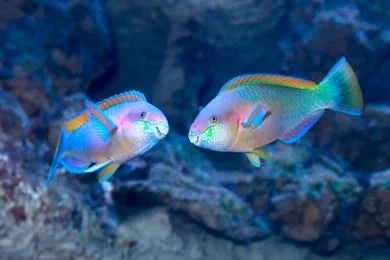
Terminal Phase (TP):
- Large size
- Brilliant blues, greens, yellows
- Always male (transformed females)
- Highly territorial “supermales”
Supermales: The Ultimate Transformers
Terminal-phase parrotfish aren’t just bigger they’re biologically superior in every way. These sex-changing animals become:
- 40-60% larger body mass
- 10x more aggressive
- Controllers of harems with 5-20 females
- Monopolizers of prime feeding territories
- Different spawning behavior (pair spawning vs group spawning)
The Transformation Process
Trigger: Death or absence of the dominant terminal male
Timeline: 2-4 weeks for complete fish gender transformation
Physical Changes:
- Ovarian tissue degrades
- Testicular tissue develops
- Pigment cells activate for brilliant coloration
- Skeletal structure reinforces for combat
- Brain chemistry shifts for territorial aggression
Why This Matters for Reefs
Parrotfish are keystone species in reef ecosystems. The loss of these hermaphroditic species has serious consequences:
- Control algae growth on coral
- Create sand for beaches
- Maintain reef health through grazing
- Support tourism economies
Overfishing parrotfish has led to reef degradation in many areas because algae overgrows and smothers coral showing how important these animals that change sex are to ocean health.
5. Hawkfish: The Back-and-Forth Switcher
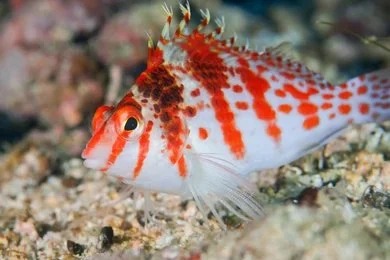
Scientific Name: Cirrhitidae family
Type of Change: Bidirectional hermaphroditism
Habitat: Indo-Pacific coral reefs
The Flexible Gender Strategy
Unlike most fish that change gender, hawkfish possess an extraordinary flexibility: they can change from female to male AND potentially back to female again, depending on social circumstances.
This bidirectional sequential hermaphroditism is rare and fascinating.
How Hawkfish Social Structure Works
Hawkfish live in small harems:
- 1 dominant male (usually the largest individual)
- 3-7 females of varying sizes
- Strict hierarchy is maintained through displays and occasional fighting
The Transformation Dance
Female to Male (Most Common):
When the dominant male disappears, these sex-changing fish act fast:
- The largest female assumes a male role within hours
- Behavioral changes happen first (aggression, courting)
- Physiological changes follow over 10-21 days
- Complete sex reversal is achieved in about 3 weeks
Male to Female (Less Common):
When a much larger male arrives:
- Current male suppresses male characteristics
- May revert to female form over several weeks
- Rejoins the harem as a subordinate female
This flexibility makes hawkfish some of the most adaptable animals that change gender in the ocean.
The Opportunistic Advantage
This bidirectional ability provides incredible reproductive flexibility:
✓ Ensures breeding always occurs
✓ Allows individuals to maximize reproductive role based on size
✓ Prevents energy waste by maintaining male traits when unnecessary
✓ Creates genetic diversity through different mating combinations
6. Ribbon Eel: The Three-Stage Wonder
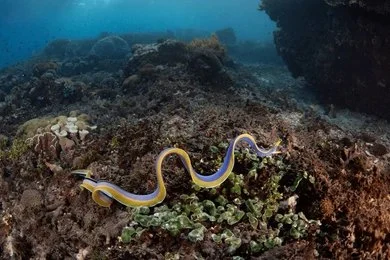
Scientific Name: Rhinomuraena quaesita
Type of Change: Protandrous (male to female)
Habitat: Indo-Pacific coral reefs
One Species, Three Distinct Looks
Ribbon eels undergo one of the most visually dramatic transformations in the ocean. These gender-changing fish cycle through three completely different color phases:
Juvenile Stage:
- Jet black body with a yellow dorsal fin
- Length: 15-30 cm
- Sex: Undifferentiated
Male Stage:
- Electric blue body
- Yellow jaw and fins
- Length: 65-80 cm
- Sex: Fully functional male
Female Stage:
- Completely yellow body
- No blue coloration
- Length: 90-130 cm
- Sex: Fully functional female
The Mysterious Transformation Trigger
Scientists still don’t fully understand what triggers ribbon eels to undergo protandry. Unlike socially-triggered sex-changing animals, ribbon eels seem to follow a more size/age-dependent pattern:
Current Hypothesis:
- Eels remain male until reaching approximately 65-80 cm
- At this size threshold, the transformation to female begins
- The process takes several months
- Females are always the largest individuals in any population
Why So Little Research?
Ribbon eels are notoriously difficult to study:
- Live in crevices and holes (secretive behavior)
- Extremely sensitive to stress (hard to keep in captivity)
- Deep water habitat (challenging to observe)
- Low population density (rarely encountered)
Most of what we know about these hermaphroditic species comes from aquarium observations and opportunistic field encounters.
Conservation Concern: Because transformation triggers aren’t well understood, and wild populations may be declining due to collection, ribbon eels represent an important gap in our understanding of animals that change sex.
7. Moray Eels: The Simultaneous Switchers
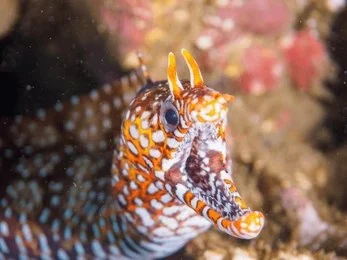
Scientific Name: Muraenidae family
Type of Change: Various (including simultaneous hermaphroditism)
Habitat: Tropical and temperate ocean reefs worldwide
The Most Complex Gender System
Moray eels take gender flexibility to another level. These sex-changing animals can be:
- Sequential hermaphrodites (change from one sex to another)
- Simultaneous hermaphrodites (both sexes at once)
- Reversible changers (switch back and forth)
How Can They Be Both Sexes?
Some moray species possess both functional ovarian and testicular tissue simultaneously, allowing them to:
- Produce both eggs and sperm
- Self-fertilize (in rare emergency situations)
- Act as male or female depending on partner
- Maximize reproductive opportunities in sparse populations
Species-Specific Strategies
Dragon Moray (Enchelycore pardalis):
- Protogynous (female to male)
- Transforms around 60-70 cm in length
- Males develop larger heads and teeth
Mediterranean Moray (Muraena helena):
- Can be a simultaneous hermaphrodite
- Possesses both ovarian and testicular tissue
- Sex role depends on partner size and behavior
Undulated Moray (Gymnothorax undulatus):
- Sequential hermaphrodite
- Males can revert to females under certain conditions
Why Such Diversity?
Moray eels occupy one of the most challenging niches in the ocean. These fish that change gender need maximum reproductive flexibility because they:
- Hunt alone
- Live in isolated holes and crevices
- Rarely encounter potential mates
- Face unpredictable environmental conditions
Having multiple gender strategies allows different moray species to adapt to varying levels of population density and environmental conditions.
8. Slipper Limpet: The Stacking Hermaphrodite
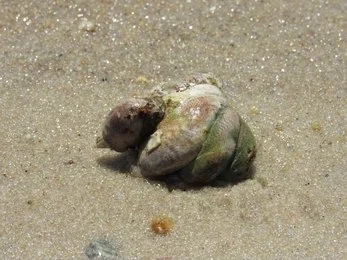
Scientific Name: Crepidula fornicata
Type of Change: Protandrous (male to female)
Habitat: Coastal waters of the North Atlantic
Nature’s Most Unusual Living Arrangement
Imagine if your entire dating life involved literally stacking yourself on top of potential partners. For slipper limpets, this bizarre reality is just standard operating procedure.
These animals that change gender have one of the strangest social systems in nature.
The Tower of Gender
Slipper limpets form chains or stacks of individuals:
Bottom of Stack:
- Oldest individuals
- All female
- Largest size
- Attached to rock/shell
Middle of Stack:
- Transitioning individuals
- Intermediate size
- Possess both male and female tissues
Top of Stack:
- Youngest individuals
- All male
- Smallest size
- Mobile (can move to new stacks)
How It Works
Young Limpet Life:
- Hatches as a free-swimming larva
- Settles on a rock or an existing limpet stack
- Develops as a male if settling on older individuals
- Develops as a hermaphrodite if settling alone
The Transformation: As more males settle on top, lower males transform to female through sequential hermaphroditism:
- Middle-stack position = both reproductive organs active
- Bottom-stack position = completely female
The Evolutionary Logic
This system is brilliantly efficient for these sex-changing animals:
✓ Every stack guaranteed to have both sexes
✓ No energy wasted searching for mates
✓ Fertilization assured (males literally on top of females)
✓ Larger females produce more eggs
✓ Smaller males are mobile (can find optimal stacks)
The Invasive Species Problem
Slipper limpets native to North America were accidentally introduced to European waters in the late 1800s. They’ve become invasive pests because:
- Reproduce prolifically (hermaphroditic flexibility)
- Form massive beds that smother native shellfish
- Alter the bottom habitat
- Compete with commercial oysters
Their gender-changing ability actually makes them MORE successful as invaders.
9. Barramundi: The Commercial Gender-Changer
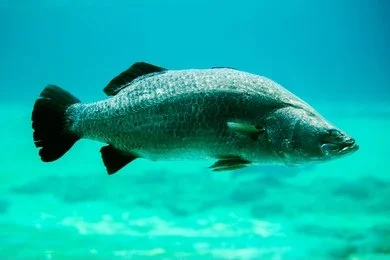
Scientific Name: Lates calcarifer
Type of Change: Protandrous (male to female)
Habitat: Indo-Pacific coastal waters and rivers
The Fish on Your Dinner Plate
Barramundi is a prized commercial and recreational fish species, popular in restaurants worldwide. What most diners don’t realize is that every large barramundi they eat was once male.
These fish that change gender are an important food source and a conservation challenge.
Life Cycle and Transformation
Age 2-3 Years:
- Fish mature as males
- Length: 30-50 cm
- Actively breed as males
Age 4-6 Years:
- Transition period
- Some individuals begin protandry
- Length: 50-75 cm
Age 7+ Years:
- All large individuals are female
- Length: 75-180 cm
- Produce millions of eggs
Why This Transformation Pattern?
Size-Advantage Hypothesis in Action (why animals that change sex evolved):
Small = Male makes sense because:
- Sperm production requires less energy
- Small males can still fertilize many eggs
- Don’t need to carry developing eggs
Large = Female makes sense because:
- Larger body = more space for eggs
- Can produce 1-32 million eggs per season
- Higher survival rates for offspring
Fishing Industry Implications
Barramundi’s sequential hermaphroditism creates management challenges:
Problem: Most fishing pressure targets large fish (which are all female)
Consequences:
- Removes breeding females from the population
- Skews sex ratio toward young males
- Reduces overall reproductive capacity
- Requires strict size limits and catch quotas
Sustainable Management Strategies:
- Slot limits (protecting both small and large fish)
- Seasonal closures during spawning
- Catch-and-release programs for large specimens
Aquaculture Advantage
Farm-raised barramundi avoid these issues:
- Controlled breeding populations
- Sex ratios are managed intentionally
- Harvest before or after transformation
- No impact on wild populations
Fun Fact: Some aquaculture operations deliberately keep fish at sizes where they’ll remain male, as faster-growing males reach market size more efficiently!
10. California Sheephead: The Coastal Transformer
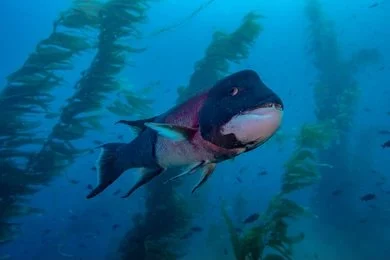
Scientific Name: Semicossyphus pulcher
Type of Change: Protogynous (female to male)
Habitat: Kelp forests off the California coast
The Guardian of Kelp Forests
California sheephead are keystone species in Pacific kelp forest ecosystems, playing crucial roles in controlling sea urchin populations and maintaining ecosystem balance.
These gender-changing fish are ocean guardians.
The Dramatic Color Transformation
A few fish that change gender undergo such striking visual changes:
Female/Juvenile Coloring:
- Uniform pink to rose-red
- Modest size
- Delicate features
Male Coloring:
- Black head and anterior portion
- Thick white chin band
- Red/orange midsection
- Black posterior and tail
- Massive protruding forehead
- Prominent canine teeth
Transformation Timeline and Triggers
Age/Size Dependent:
- Females: 4-6 years old, 25-35 cm
- Transformation begins: 6-8 years old, 35-45 cm
- Full males: 8-12 years old, 45-70 cm
Process:
- Takes 1-2 years for complete fish sex reversal
- Color changes happen gradually
- Skeletal restructuring occurs
- Behavioral shifts accelerate near completion
Ecological Importance
California sheephead males are ecological warriors:
Powerful Jaws:
- Can crush sea urchins (major kelp grazers)
- Eat hard-shelled mollusks
- Control invertebrate populations
Without Sheephead:
- Sea urchin populations explode
- Kelp forests get devoured
- Ecosystem collapses into “urchin barrens”
- Fish diversity plummets
The Spearfishing Problem
California sheephead face serious conservation challenges:
Issue: Spearfishers preferentially target large, colorful males
Consequences:
- Removes breeding males
- Prevents females from transforming (suppressed by male presence)
- Creates female-biased populations
- Reduces genetic diversity
Current Protections:
- Minimum size limits
- Bag limits
- Marine protected areas
- Seasonal restrictions in certain zones
Climate Change Concerns
Warming waters are pushing sheephead populations into uncertain futures. Just as underwater volcanoes create and destroy ocean habitats, human-driven climate change is reshaping where and how these animals that change gender can survive.
The Science of Sex Change: How Does It Actually Work?
Hormonal Orchestration
Fish sex reversal isn’t random; it’s a precisely controlled biological process:
Male to Female (Protandry):
- Suppression: Testosterone and other androgens decrease
- Activation: Estrogen production increases
- Regression: Testicular tissue breaks down
- Development: Ovarian tissue develops and matures
- Completion: Fully functional female reproductive system
Female to Male (Protogyny):
- Suppression: Estrogen levels drop
- Activation: Testosterone production increases
- Regression: Ovarian tissue degrades
- Development: Testicular tissue grows and matures
- Completion: Fully functional male reproductive system
Genetic Control
Recent research has identified specific genes involved in marine life gender transformation:
Key Discoveries:
2018 Clownfish Study: Researchers at Georgia Institute of Technology found that sex change activates specific genetic pathways similar to those used during initial sex determination in other fish.
2020 Wrasse Research: Scientists discovered that social stress triggers a cascade of gene expression changes within 24-48 hours, beginning the transformation process.
2022 Transcriptome Analysis: Gene expression mapping revealed thousands of genes are up-regulated or down-regulated during transformation in sequential hermaphrodites, involving:
- Steroid hormone synthesis
- Brain neuroplasticity
- Gonadal restructuring
- Behavioral modification
Brain Changes
It’s not just the body that changes in animals that change sex the brain restructures too:
Behavioral Programming:
- Aggression circuits
- Mating behaviors
- Territorial responses
- Social recognition systems
Neuroplasticity in Action: Fish brains demonstrate remarkable flexibility, rewiring neural pathways to support their new sex role.
The Mystery of Triggers
Different sex-changing animals use different triggers:
Social Cues:
- Presence/absence of dominant sex
- Hierarchical position
- Population sex ratio
Environmental Cues:
- Water temperature
- Food availability
- Population density
Physiological Cues:
- Body size
- Age
- Health status
Many hermaphroditic species use combination triggers, creating sophisticated decision-making systems.
Evolution of Sequential Hermaphroditism
How Did This Ability Evolve?
Sequential hermaphroditism likely evolved independently multiple times across different taxonomic groups:
Evidence from Phylogenetics:
- Over 500 fish species change gender
- Appears in at least 27 different fish families
- Evolved separately in each lineage
- Indicates strong evolutionary pressure favoring this trait
The Evolutionary Advantages
Size-Advantage Model: When reproductive success differs between males and females at different sizes, fish gender transformation becomes advantageous.
Example: Bluehead Wrasse
- Small fish: Better reproductive success as females (produce some eggs)
- Large fish: Better reproductive success as males (control many females)
- Result: Start female, become male when large enough
Sex-Allocation Theory: Organisms should “invest” in being the sex that maximizes reproductive output at each life stage.
Environmental Pressures That Favor Sex Change
Reef Environments:
- Limited space
- Small, isolated populations
- High predation
- Difficulty finding mates
All create selection pressure for:
- Reproductive flexibility
- Guaranteed breeding pairs
- Efficient use of individuals
- Genetic diversity
This is why animals that change gender are so common in reef environments.
Conservation and Human Impact
Threats to Gender-Changing Species
1. Overfishing:
Preferential removal of one sex (usually larger) in sex-changing fish populations creates serious problems:
- Disrupts sex ratios
- Prevents the transformation from occurring
- Reduces the population reproductive capacity
Example: Many large male parrotfish and California sheephead are targeted by fishers specifically for their size and appearance, removing them before they can breed extensively.
2. Habitat Destruction:
- Coral reef degradation
- Coastal development
- Pollution
- Climate change
3. Aquarium Trade:
- Overcollection of colorful species
- Removal before sexual maturity
- Disrupts population dynamics
- Particularly impacts ribbon eels and some wrasses
The Climate Change Connection
Rising ocean temperatures are affecting animals that change sex in multiple ways:
Direct Effects:
- Altered transformation timing
- Disrupted hormonal triggers
- Thermal stress during transformation
- Changes in food availability
Indirect Effects:
- Coral bleaching destroys habitat
- Altered prey populations
- Changes in ocean chemistry
- Range shifts and population isolation
What Can We Do?
Conservation Strategies:
1. Marine Protected Areas:
- Create no-take zones
- Allow populations of gender-changing fish to maintain natural sex ratios
- Protect critical habitat
- Enable species recovery
2. Sustainable Fishing Practices:
- Size limits protect both small and large fish
- Seasonal closures during spawning
- Gear restrictions
- Catch quotas based on population science
3. Habitat Protection:
- Coral reef restoration
- Coastal zone management
- Pollution reduction
- Climate change mitigation
4. Responsible Aquarium Trade:
- Captive breeding programs
- Sustainable collection limits
- Education about hermaphroditic species biology
- Support for aquaculture alternatives
Success Stories
Great Barrier Reef Marine Park:
- Established no-take zones
- Parrotfish populations recovering
- Natural sex ratios restored in sequential hermaphrodites
- Ecosystem health improving
California Marine Protected Areas:
- California sheephead populations are stabilizing
- More large males are present
- Kelp forest ecosystems are healthier
- Serves as a model for other regions
Sex Change in Other Animal Groups
Beyond Fish: Other Gender-Changers
While fish that change gender dominate the list of sequential hermaphrodites, they’re not alone:
Gastropod Mollusks:
- Slipper limpets (discussed above)
- Some sea slugs
- Certain land snails
Echinoderms:
- Some sea stars can change sex
- Triggered by environmental conditions
- Less well-studied than fish
Crustaceans:
- Some shrimp species
- Environmental sex determination
- Can reverse under certain conditions
Amphibians:
- Some frog species show limited sex reversal
- Typically environmentally induced
- Controversial research area
Why Is It Rare in Mammals?
Mammals (including humans) cannot become animals that change gender because:
Genetic Determination:
- Sex chromosomes (XX/XY system)
- Fixed at conception
- Controls the entire developmental pathway
Developmental Complexity:
- Internal reproductive organs
- Complex endocrine systems
- Brain sexually differentiated during development
Evolutionary History:
- Evolved different reproductive strategies
- Internal fertilization
- Parental care requirements
The mammalian reproductive system is “locked in” far earlier in development than in sex-changing fish and other species.
Common Myths About Animals That Change Gender
Debunking the Confusion
Myth 1: “These animals are confused about their gender.”
Reality: This is a normal, evolutionarily advantageous biological process that has been refined over millions of years. Sequential hermaphroditism is not confusion, it’s a sophisticated adaptation.
Myth 2: “They can change back and forth whenever they want.”
Reality: Most animals that change sex do so only once in their lifetime. A few species, like hawkfish, can reverse, but it’s rare and requires specific triggers. It’s not a voluntary choice.
Myth 3: “This only happens in fish.”
Reality: While most common in fish that change gender, some mollusks, echinoderms, and crustaceans also show this ability.
Myth 4: “The transformation is instant.”
Reality: Marine life gender transformation takes anywhere from days to years, depending on species. Complete physiological restructuring takes time.
Myth 5: “They’re weaker than normal animals.”
Reality: Sex-changing animals are successful, thriving species. Their flexibility is an evolutionary advantage, not a weakness.
The Wonder of Biological Flexibility
What This Tells Us About Life
These 10 extraordinary animals that change gender demonstrate that biological sex is far more complex and flexible than we often assume. From the rapid transformations of bluehead wrasse to the multi-year journey of kobudai, from the stacked communities of slipper limpets to the mysterious ribbon eels, nature has crafted countless solutions to reproductive challenges.
Key Takeaways
- Sex is Not Always Fixed: In many species, sex can change across an individual’s lifetime based on environmental and social factors.
- Evolution is Creative: The diversity of fish sex reversal mechanisms shows evolution’s ability to find unexpected solutions to survival challenges.
- Environment Shapes Biology: Social, physical, and environmental factors all influence when and how sequential hermaphroditism occurs.
- Flexibility is Strength: These hermaphroditic species thrive precisely because of their adaptability.
- We Have Much to Learn: Despite decades of research, many aspects of gender-changing animals remain mysterious.
The Bigger Picture
Just like horned lizards that can squirt blood from their eyes, these sex-changing fish remind us that nature operates on principles far more creative and flexible than our everyday experience might suggest.
The underwater world where many of these transformations occur is itself constantly changing, shaped by forces from volcanic activity, creating new habitats, and the slow work of creatures like parrotfish creating beaches grain by grain.
Conclusion: Celebrating Nature’s Diversity
The ability to change sex represents one of the most elegant solutions to reproductive challenges that evolution has ever produced. These 10 animals that change gender from the familiar clownfish to the mysterious ribbon eel demonstrate that biodiversity extends not just to different species, but to radically different life strategies within species.
Their existence challenges us to:
- Question assumptions about biological absolutes
- Appreciate the complexity of reproductive strategies
- Protect marine ecosystems that harbor such diversity
- Support scientific research into sequential hermaphrodites
- Recognize that there’s always more to learn about life on Earth
Final Thoughts
Nature continuously amazes us with its creativity and adaptability. The animals that change sex are living proof that life finds extraordinary ways to thrive, adapt, and survive. They remind us that the natural world operates on principles far more nuanced and sophisticated than simple categorization can capture.
As we face unprecedented environmental challenges, these gender-changing fish also serve as indicators of ecosystem health. Their survival depends on healthy oceans, stable climates, and sustainable human practices. Protecting them means protecting the intricate web of life that makes our planet so remarkable.
Take Action: How You Can Help
Support Marine Conservation
- Donate to organizations protecting coral reefs and ocean habitats
- Participate in beach cleanups
- Reduce plastic use
- Support sustainable seafood choices
Be a Responsible Consumer
- Research before buying aquarium fish
- Choose sustainably caught or farmed seafood
- Avoid products that damage marine environments
Spread Awareness
- Share information about these amazing sex-changing animals
- Support science education
- Encourage others to appreciate marine biodiversity
Advocate for Protection
- Support marine protected areas
- Contact legislators about ocean conservation
- Vote for policies that address climate change
Frequently Asked Questions About Sex-Changing Fish
Q1: Can these animals choose when to change their gender?
No. The transformation in animals that change gender is triggered by specific environmental, social, or physiological conditions, not conscious choice. It’s an automatic biological response controlled by hormones and genes.
Q2: How common are sex-changing animals in nature?
Sequential hermaphroditism is found in approximately 2% of fish species (over 500 species), various invertebrates, and a few other animal groups. While uncommon, it’s a well-established biological phenomenon.
Q3: Is the sex change painful for these fish?
There’s no evidence that fish sex reversal causes pain. It’s a natural biological process their bodies are designed to undergo, regulated by hormones and genetic programming over days to years.
Q4: Will all individuals in these species eventually change sex?
Not necessarily. Only those fish that change gender in the right social position, size, or environmental conditions typically transform. Some individuals live their entire lives as their birth sex.
Q5: Can aquarium fish change their gender?
Yes, if they’re a sequential hermaphrodite species and conditions are right. Many aquarists have observed clownfish and other sex-changing fish transforming in tanks when the dominant fish dies.
Q6: Could mammals ever evolve this ability?
Extremely unlikely. Mammalian sex determination is chromosomally fixed at conception and involves complex developmental pathways that are “locked in” very early. Fish have much more flexible reproductive systems that allow marine life gender transformation.
Q7: What’s the fastest sex change in nature?
Bluehead wrasse can complete their fish gender transformation in as little as 10-14 days, making them among the fastest gender-changing animals known to science.
