

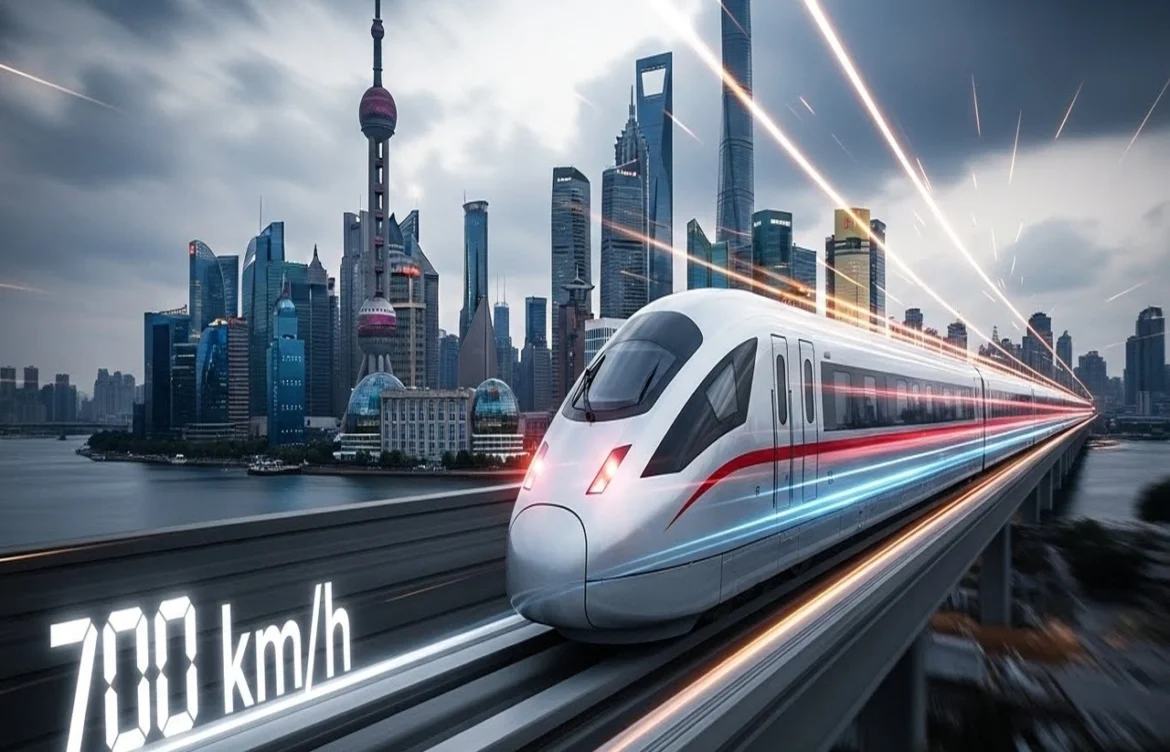
China’s Insane Maglev Train 700 km/h World Record in Just 2 Seconds
The Future Just Arrived at 700 km/h in Under 2 Seconds
Picture this: December 2025, somewhere in China’s secretive National University of Defense Technology (NUDT) testing facility. A sleek, 1-ton experimental maglev train vehicle sits on a track, looking like something straight out of a sci-fi movie. Engineers huddle around monitors, counting down. Three. Two. One.
Then BAM!
In less time than it takes you to read this sentence, that vehicle rockets from zero to 700 kilometers per hour (435 mph). No roaring engines. No screaming tires. Just a blur of motion and a misty trail left hanging in the air. The only sound? A futuristic whoosh that makes your heart skip.
Welcome to the world of maglev trains in 2026, where trains don’t just run, they float. Where friction is a thing of the past, and the question isn’t “how fast can we go?” but “how fast do we want to go?”
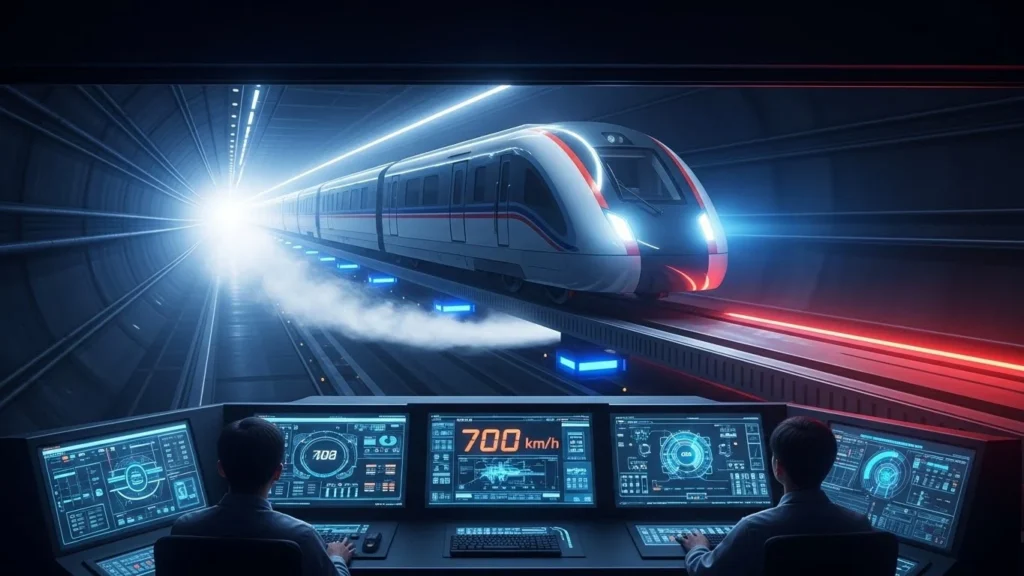
As we sit here in January 2026, magnetic levitation technology isn’t science fiction anymore. It’s reality. China just shattered maglev train speed records with that December test, proving that trains can accelerate faster than most supercars. The Shanghai maglev already whisks passengers at 431 km/h on their daily commute, making it the world’s fastest operational train.
In this guide, we’re exploring everything about maglev train technology. How do maglev trains work? What’s it like to ride the maglev train in Shanghai at breakfast-blurring speeds? Why is Japan spending over $65 billion on their maglev high speed dreams? And why doesn’t America have these incredible trains?
So buckle up or don’t, because these trains are so smooth you barely need seatbelts.
Table of Contents
What Is a Maglev Train? Which Countries Have Them?
The Magnetic Levitation Dream
The idea of magnetic levitation isn’t new. Engineers have been sketching floating trains since the early 1900s. But it wasn’t until the 1960s that technology caught up with imagination. Scientists in Germany, Japan, and the United States started experimenting with magnetic propulsion, asking: What if we could eliminate friction?
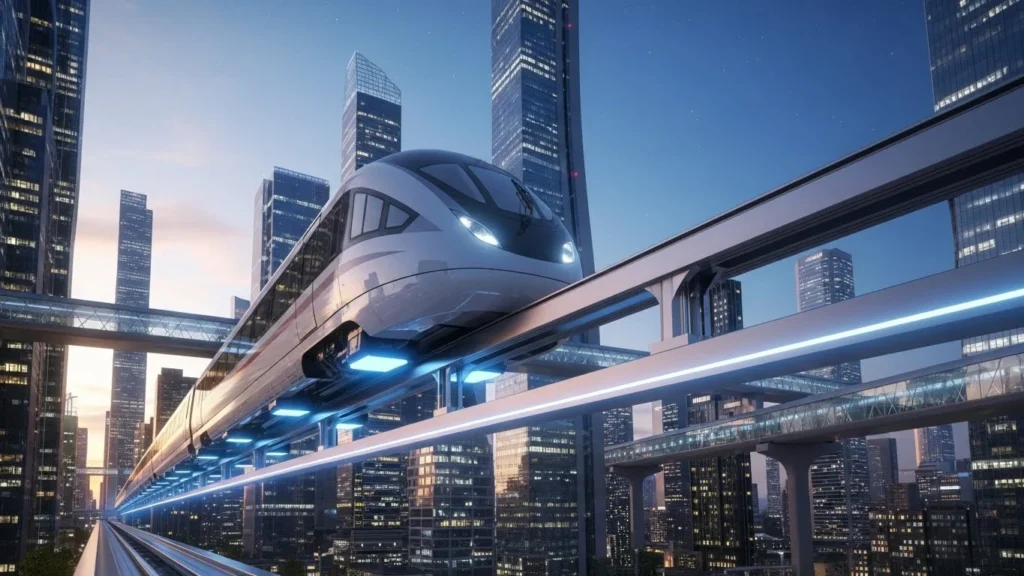
Traditional trains have wheels touching rails. That contact creates friction, heat, wear, noise and speed limits. But what if a maglev train could hover above the track, suspended by invisible magnetic forces? No contact. No friction. Just pure speed.
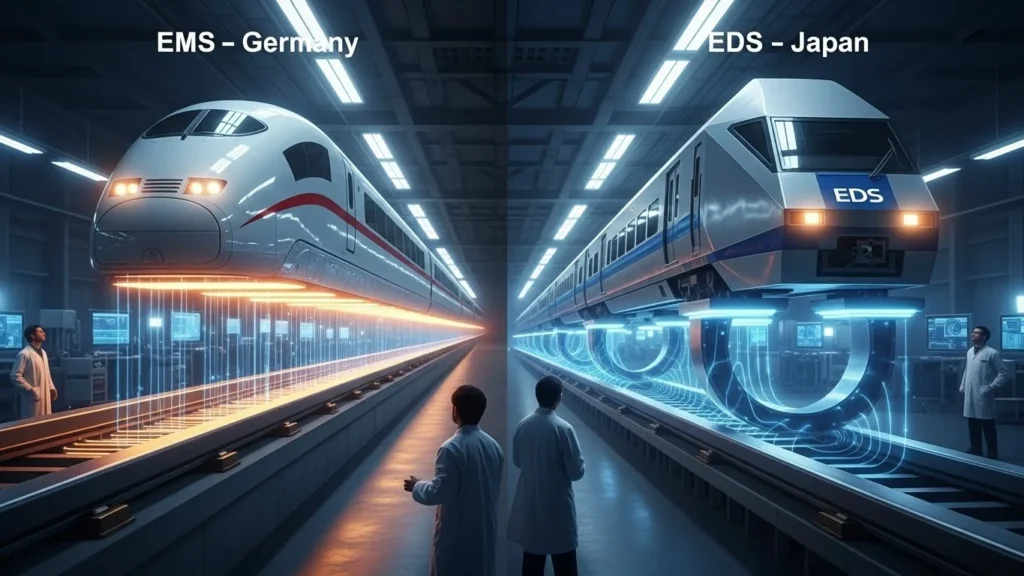
By the 1970s and 80s, both Germany and Japan had working maglev prototypes. Germany pioneered electromagnetic suspension (EMS) technology with their Transrapid system. Japan went with electrodynamic suspension (EDS), which uses superconducting magnets.
2026 Status: Who Has Maglev Trains?
Despite all the hype, only a handful of operational maglev train lines exist worldwide as of January 2026:
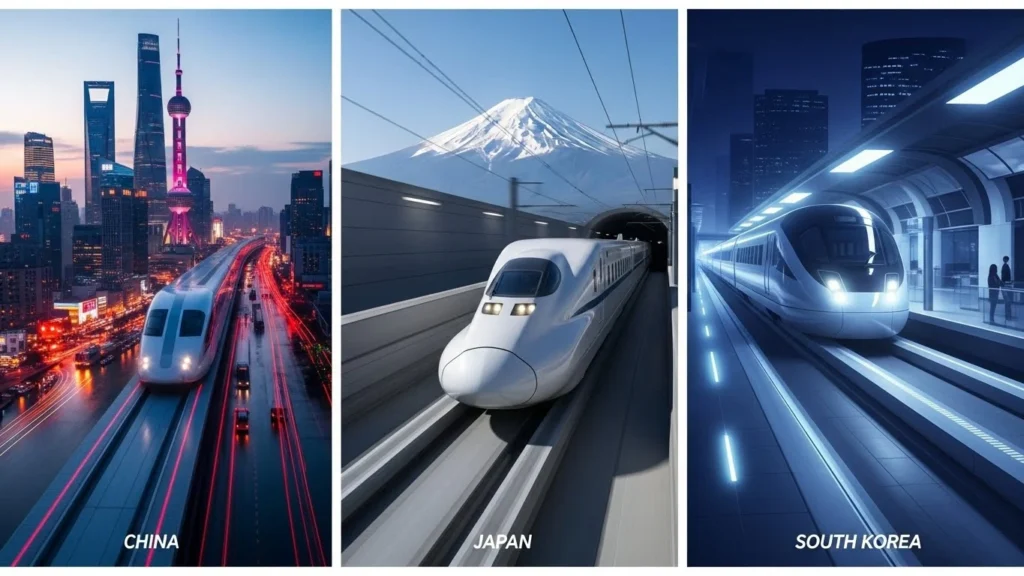
China:
- Shanghai Maglev (2004-present): The world’s first and fastest commercial maglev train, hitting 431 km/h (268 mph) in regular service
- Changsha Maglev Express (2016-present): Lower-speed maglev (100 km/h) connecting the airport
- Beijing Subway Line S1 (2017-present): Medium-speed urban maglev line
Japan:
- Linimo (2005-present): 9-kilometer urban maglev in Nagoya, running at 100 km/h
South Korea:
- Incheon Airport Maglev (2016-present): Short, low-speed connector at 110 km/h
That’s it. Just five operational commercial lines in the entire world, and only one (maglev train Shanghai) runs at truly high speeds.
Testing Facilities:
- China: Multiple test facilities, including NUDT that achieved 700 km/h
- Japan: 42.8-kilometer Yamanashi Test Track where L0 Series reached 603 km/h in 2015
- Germany: Decommissioned their test track in 2011
- United States: University research only, no operational lines
China dominates in deployment, Japan leads in long-term ambition, and everyone else is watching from the sidelines.
How Do Maglev Trains Work?
Let’s get into the magic no physics degree required.
The Core Principle: Floating on Magnets
Remember playing with magnets as a kid? Push two magnets together the wrong way and they repel each other. That invisible force is the secret to maglev trains. Instead of wheels on rails, maglev trains use powerful magnets to:
- Levitate: Lift the train above the guideway (track)
- Propel: Push the train forward using linear motor technology
- Guide: Keep the train stable and centered
No physical contact means no friction. No friction means higher maglev train speeds, quieter rides, less maintenance, and incredible efficiency.
Two Types of Maglev Technology
Electromagnetic Suspension (EMS) – The Attractive Type
How it works: EMS ( Electromagnetic Suspension ) uses conventional electromagnets mounted on the train that are attracted to iron rails on the guideway below. Careful electronic control keeps them from touching.
The levitation gap: Just 8-15 millimeters (about half an inch). The maglev train hovers less than an inch above the track.
Control system: Thousands of electronic adjustments per second keep the gap stable.
Who uses it: Germany’s Transrapid technology (used in Shanghai maglev), South Korea’s system.
Pros: Works at all speeds, including from standstill. Simpler guideway construction.
Cons: Requires constant power to maintain levitation, even when stationary.
Electrodynamic Suspension (EDS) – The Repulsive Type
How it works: EDS ( Electrodynamic Suspension ) uses superconducting magnets on the train that induce currents in coils built into the guideway. These induced currents create magnetic fields that repel the train’s magnets.
The levitation gap: 10 to15 centimeters (4 to 6 inches). Much higher float than EMS.
The catch: EDS only works above around 100 km/h. Below that, the maglev train runs on wheels. Once it reaches speed, it lifts off.
Who uses it: Japan’s SCMaglev system.
Pros: No power needed to maintain levitation once moving. More stable. Better ride comfort.
Cons: Needs expensive superconducting magnets cooled to -269°C with liquid helium. Requires wheels for low speeds.
How They Move: Linear Motor Propulsion
Both maglev train systems use linear motors for propulsion. Think of a regular electric motor “unrolled” into a straight line:
- The guideway has coils creating a traveling magnetic wave
- The train has magnets that interact with this wave
- The wave pulls the train along like a surfer riding a wave
- Maglev train speed is controlled by adjusting the wave frequency
No engine. No combustion. No spinning wheels. Just magnetic fields pushing and pulling a floating train.
Maglev Train Speed: Records & Reality
This is where maglev trains go from cool to mind-blowing.
The Speed Hierarchy
When discussing maglev train speed, we need three categories:
- Operational speeds: What passengers experience in regular service
- Test speeds: Records set on experimental tracks
- Future potential: What engineers think is possible
Medium-Speed Urban Maglev: 100-110 km/h
Japan’s Linimo, South Korea’s Incheon line, and China’s Changsha and Beijing lines operate in this range. They’re faster than buses but not game-changers for long-distance travel.
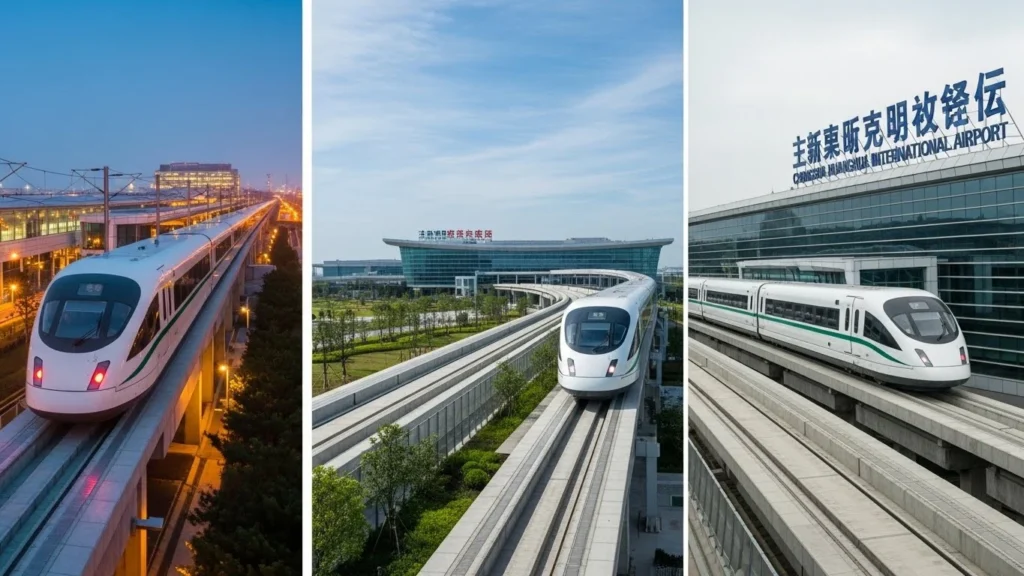
The Shanghai Maglev: 431 km/h – World’s Fastest Operational Train
Since 2004, the Shanghai Maglev has shown the world what maglev high speed can do. On most runs, it cruises at 300-350 km/h to save energy. But on select trips (usually 9:00-10:45 AM and 3:00-3:45 PM), it unleashes its full potential: 431 km/h.
That’s faster than:
- Formula 1 race cars (max around 375 km/h)
- Most small aircraft are at cruising altitude
- Any land vehicle you can legally drive
The 30-kilometer journey from Pudong Airport to Longyang Road takes just 7 minutes 20 seconds at top speed. Passengers describe it as surreal you’re moving so fast the world outside becomes a blur, but inside? Smooth as silk. No shaking, minimal noise, just a gentle hum and speed displays showing impossible numbers.
Japan’s L0 Series: 603 km/h (2015)
For years, this was the fastest any maglev train had traveled. In April 2015, Japan’s L0 Series maglev hit 603 km/h on the Yamanashi Test Track, carrying actual passengers. Seven people experienced speeds faster than most commercial airplanes during takeoff.
Japan was testing technology for the Chuo Shinkansen line, planned to operate at 505 km/h in regular service. That record stood for over a decade. Until last month.
China’s December 2025 Record: 700 km/h in Under 2 Seconds
On a December day in 2025, researchers at China’s National University of Defense Technology achieved the impossible: they accelerated a 1-ton test vehicle from 0 to 700 kilometers per hour in under 2 seconds.
700 km/h. In less than two seconds.
For context:
- That’s 0-435 mph in under 2 seconds
- Acceleration force around 10-15g (10-15 times gravity)
- A Tesla Model S Plaid does 0-60 mph in 1.99 seconds. This maglev did 0-435 mph in the same time
- Fighter jets during carrier launches experience similar acceleration
This wasn’t a passenger train, no human could survive that acceleration. But as a technology demonstration, it proved that maglev propulsion systems can achieve speeds approaching 700 km/h. It’s part of China’s research into ultra-high-speed ground transportation.
Speed Comparison
| Vehicle/Train | Top Speed | Type |
|---|---|---|
| Japan Shinkansen | 320 km/h (200 mph) | Operational wheeled train |
| Shanghai Maglev | 431 km/h (268 mph) | Operational maglev |
| Japan L0 Series | 603 km/h (375 mph) | Test maglev (manned) |
| China NUDT Vehicle | 700 km/h (435 mph) | Test maglev (unmanned) |
| Commercial Airliner | 900–950 km/h | Air travel |
Maglev trains are already competitive with air travel over short to medium distances (under 1,000 km), especially when you factor in airport security and boarding times.
Riding the Shanghai Maglev: What’s It Like?
The Route & Experience
The maglev train Shanghai connects Pudong International Airport to Longyang Road Metro Station, 30 kilometers (18.6 miles). It was designed as proof-of-concept and airport connector, but what a proof it is.
The Journey:
You board at the airport terminal, ticket in hand (about 50 Chinese Yuan or $7-8 USD). The platform looks modern, except the maglev train hovering beside you looks like it arrived from 2050.
The doors close. No jerky start, the train glides so smoothly using magnetic levitation that you barely notice movement. Within seconds, you’re at 100 km/h. Then 200. Then 300.
Inside, flat-screen displays show your current maglev speed in real-time. Passengers watch the numbers climb. 350 km/h. 380 km/h. 400 km/h.
At 431 km/h, the landscape outside is incomprehensible. Buildings, fields and overpasses all just colored streaks. Your brain can’t process this speed from ground level. But inside? You could balance a coin on its edge. No rattling. No shaking. Just smooth, impossible speed.
Seven minutes twenty seconds later, you’re pulling into Longyang Road. The train decelerates just as smoothly. You step off feeling exhilarated and slightly cheated you wanted more.
2026 Ticket Prices
As of January 2026, the Shanghai Maglev runs strong after 22 years:
- Standard one-way: ~50 CNY ($7-8 USD)
- Round-trip: ~80 CNY ($11-12 USD)
- VIP seats: ~100 CNY ($14 USD)
A taxi from Pudong Airport costs 150-200 CNY and takes 45-60 minutes in traffic. The maglev gets you to the metro in under 8 minutes for a fraction of the cost.
If you visit Shanghai, riding the maglev isn’t optional, it’s essential. It’s the fastest, smoothest seven minutes you’ll experience on land.
Maglev vs Bullet Trains: The Real Differences
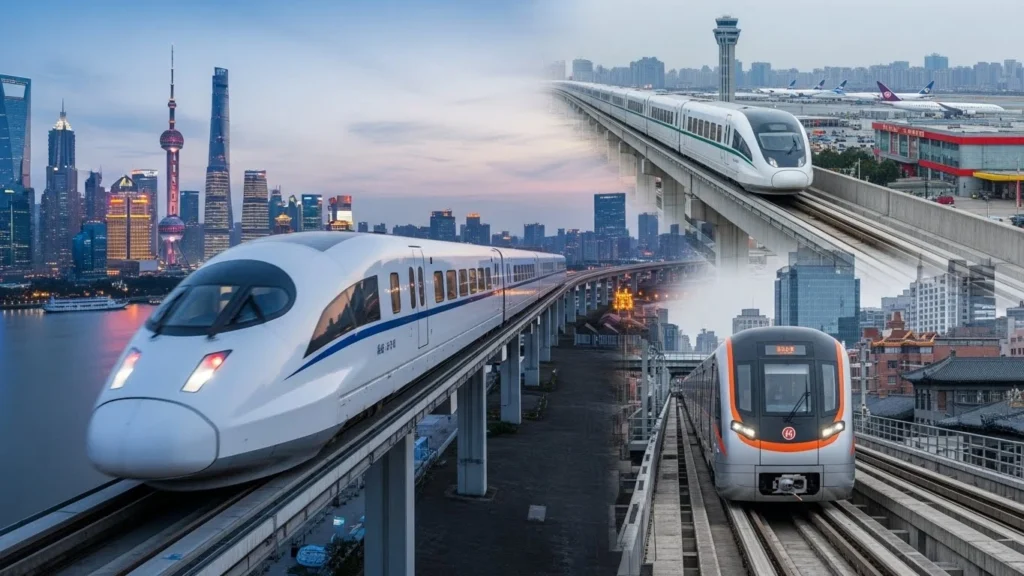
How does maglev compare to traditional high-speed rail like Japan’s famous bullet trains?
Speed Comparison
| Category | Maglev | Bullet Train |
|---|---|---|
| Top operational speed | 431 km/h (Shanghai) | 320 km/h (Shinkansen) |
| Test record | 603 km/h (Japan L0, 2015) | 574.8 km/h (French TGV, 2007) |
| Typical cruising | 300-430 km/h | 250-320 km/h |
Winner: Maglev, but only by a margin. Shanghai’s 431 km/h beats any conventional high-speed train in regular service.
Do Japanese Bullet Trains Use Maglev?
No this confuses many people. Japan’s famous Shinkansen bullet trains use conventional steel wheels on steel rails. They’re incredibly fast and reliable, but not maglev.
Japan is developing maglev technology with SCMaglev for the future Chuo Shinkansen line, but that’s separate from the existing Shinkansen network.
Key Differences Beyond Speed
Construction Cost:
- Bullet trains: $25-50 million per kilometer
- Maglev: $50-100+ million per kilometer
- Winner: Bullet trains (much cheaper)
Maintenance:
- Bullet trains: Wheels and rails wear constantly, need regular replacement
- Maglev: No physical contact means minimal wear
- Winner: Maglev (lower long-term maintenance)
Energy Efficiency:
- Bullet trains: Friction wastes energy as heat
- Maglev: No friction thanks to magnetic levitation
- Winner: Maglev at medium speeds
Noise:
- Bullet trains: Wheels create significant noise at 300+ km/h
- Maglev: No wheel noise, just air resistance
- Winner: Maglev
Ride Comfort:
- Bullet trains: Modern ones are smooth but you feel vibrations
- Maglev: Floating eliminates vibrations, uncannily smooth
- Winner: Maglev
Network Integration:
- Bullet trains: Can run on both high-speed and regular rail
- Maglev: Needs dedicated guideways, can’t mix with conventional rail
- Winner: Bullet trains
The Verdict
Maglev is faster, smoother, quieter, and has lower maintenance. Bullet trains are cheaper to build, easier to integrate with existing rail networks, and have longer proven track records.
For countries with existing high-speed rail, upgrading to maglev is tough to justify. For new projects, the choice is less clear, but cost usually wins.
Why No Maglev Trains in the US?
Why doesn’t the United States have a single operational maglev train?
The American Maglev Dream (That Keeps Dying)
The U.S. has flirted with maglev for decades:
- 1990s: Federal studies explored various corridors
- 2000s: Baltimore-Washington Maglev proposal gained attention
- 2010s: Northeast Maglev pushed for Washington-New York line ($100 billion+)
- January 2025: Federal government pulled funding, citing cost concerns
Why Maglev Fails in America
1. Astronomical Costs
Building maglev infrastructure in the U.S. is insanely expensive. Land acquisition requires years of legal battles. American construction wages are higher. Environmental studies add years and billions. Estimates for Washington-New York ranged from $100-200 billion.
2. Car Culture
Americans love cars. Unlike dense Asian cities, U.S. cities are sprawling. Even with maglev high speed trains connecting city centers, most Americans still need cars to reach stations and get around at their destination.
3. Political Gridlock
Maglev projects require cooperation between federal, state, and local governments. In the U.S., that’s a nightmare. By the time everyone agrees (if ever), costs balloon and political will evaporates.
4. Lack of Urgency
Americans don’t feel a transportation crisis. Roads are congested but not unbearably. Air travel works well enough. There’s no compelling national imperative to build magnetic levitation systems.
Compare that to China, where massive urbanization demands efficient mass transit, or Japan, where geography and earthquake risks make redundant rail corridors essential.
Maglev Advantages & Disadvantages
Advantages
1. Incredible Speed – Maglev train speed far exceeds conventional rail. Shanghai’s 431 km/h and Japan’s 603 km/h test record demonstrate potential.
2. Smooth, Quiet Ride – No wheel-rail contact means no vibrations. Maglev trains provide the smoothest ride of any ground transport.
3. Lower Maintenance – No physical contact means minimal wear. Electromagnetic suspension systems require less maintenance than wheeled trains.
4. Energy Efficiency – Magnetic levitation eliminates rolling friction, the biggest energy waster in conventional rail.
5. Weather Resilience – Ice, snow, and leaves don’t affect maglev operations like they do wheeled trains.
6. Environmental Benefits – Zero direct emissions, electric powered, quieter than conventional trains.
Disadvantages
1. Astronomical Construction Costs – $50-100+ million per kilometer double or triple conventional high-speed rail.
2. Incompatibility – Maglev trains need completely new guideways. They can’t run on conventional tracks.
3. Limited Proven Record – Only five operational commercial maglev lines exist worldwide as of 2026.
4. Complex Technology – Sophisticated electromagnets, superconducting magnets, and linear motors require specialized expertise.
5. Speed Advantage Diminishes – For very short trips, acceleration dominates. For ultra-long distances, air travel wins.
The Future of Maglev Trains
China’s Continued Push
China shows no signs of slowing. With multiple operational maglev lines, ongoing research into 600+ km/h systems, and that stunning 700 km/h test, China is pushing boundaries.
Expected developments:
- More urban maglev lines connecting airports
- Medium-speed intercity maglev (200-400 km/h)
- Vacuum tube research targeting 1,000+ km/h
- Export ambitions selling maglev technology abroad
Japan’s Crucial Test
If Japan completes the Tokyo-Osaka maglev line by 2035-2045, it will definitely prove maglev trains work at scale. Success would trigger global interest. Failure would reinforce skepticism.
Everything hinges on Japan finishing this project it’s the most important maglev development in the world.
Vacuum Tube Maglev: The Ultimate Vision
Running magnetic levitation trains in evacuated tubes eliminates air resistance, allowing 1,000-4,000+ km/h. China is actively researching this with test tracks achieving 623 km/h in low-pressure environments.
But scaling to thousands of kilometers? That’s a 2040s-2050s problem at the earliest.
Conclusion
From that jaw-dropping 700 km/h test in December 2025 to the smooth wonder of the Shanghai Maglev, magnetic levitation trains represent one of humanity’s most impressive transportation technologies.
How do maglev trains work? Through elegant physics of electromagnetic suspension and electrodynamic suspension, these trains float on invisible magnetic forces, propelled by linear motors to speeds rivaling aircraft.
Maglev train speed is staggering. The Shanghai Maglev cruises at 431 km/h. Japan’s L0 Series hit 603 km/h with passengers. China’s latest test achieved 700 km/h in under 2 seconds.
Yet despite these marvels, maglev trains remain rare only five commercial lines operate worldwide. The reasons are clear: astronomical costs, political gridlock, infrastructure inflexibility, and conventional high-speed rail being “good enough.”
China will continue pushing maglev technology forward. Japan’s Chuo Shinkansen if completed will be the ultimate test. The rest of the world will watch and mostly stick with what they have.
If you ever ride a maglev train, especially the Shanghai Maglev at full speed, take it. You’ll experience a glimpse of what transportation could be—smooth, silent, impossibly fast, and just a little bit magical.
The maglev revolution is here. The question is: will it spread beyond China and Japan?
FAQs About Maglev Trains
Q: What is the fastest maglev train in the world?
The Shanghai Maglev is the fastest operational train at 431 km/h. For test speeds, Japan’s L0 Series holds the manned record at 603 km/h, while China achieved 700 km/h unmanned in December 2025.
Q: How do maglev trains work?
Maglev trains use powerful magnets to levitate above guideways, eliminating friction. Electromagnetic suspension uses an attractive force while electrodynamic suspension uses a repulsive force. Linear motors propel the train forward.
Q: Why are there so few maglev trains?
Maglev trains are extremely expensive ($50-100+ million per kilometer), require entirely new infrastructure, and offer only incremental advantages over conventional high-speed rail.
Q: How much does the Shanghai Maglev cost?
As of 2026, one-way tickets cost ~50 CNY ($7-8 USD), round-trips ~80 CNY ($11-12 USD), and VIP seats ~100 CNY ($14 USD).
Q: Do Japanese bullet trains use maglev?
No. Japan’s Shinkansen uses conventional wheels. Japan is developing a separate maglev line (Chuo Shinkansen) using a different technology.